


How Long Do Compressed Couches Last? An Industry Expert's Analysis
The furniture industry has undergone a radical transformation in the last decade. The era of waiting twelve weeks for a bulky delivery truck is fading, replaced by the convenience of "couches in a box." However, this shift in logistics has birthed a persistent question among consumers and interior designers alike: how long do compressed couches last? There is a lingering skepticism that "compressed" implies "compromised." From our professional experience in furniture design and material engineering, we can assert that compression technology does not inherently dictate lifespan; density does.

In this authoritative guide, we will dismantle the myths surrounding modular, compressed furniture. We will analyze the specific factors that determine longevity, from foam density ratings to fabric abrasion tests, and explain why modern adaptive designs like the Desk One FoldFlex are challenging traditional notions of durability.
- 1. Understanding Compression Technology: Does It Damage Foam?
- 2. Critical Factors Affecting Couch Longevity
- 3. The Density Debate: The Core of Durability
- 4. Fabric Resilience: Why Corduroy Matters
- 5. Case Study: The DeskOne FoldFlex Lifespan
- 6. Compressed vs. Traditional Couches: A Durability Comparison
- 7. Expert Tips to Extend Your Couch's Life
- 8. Summary Comparison Table
- 9. Frequently Asked Questions
- 10. References
1. Understanding Compression Technology: Does It Damage Foam?
To accurately answer the question, "how long do compressed couches last?", one must first understand the mechanics of compression. High-quality polyurethane foam is composed of open cells—tiny air pockets surrounded by polymer struts. When a couch is compressed for shipping, the air is evacuated, and the struts are bent.
From our experience, high-quality foam recovers 95% to 100% of its original shape within 24 to 48 hours of unboxing. The misconception that compression ruins a couch stems from early, low-density foams that crumbled or failed to rebound. Modern high-resiliency (HR) foams are engineered specifically to withstand this process. In fact, the ability of a material to recover from extreme compression is a testament to its structural integrity. If a couch can survive being vacuum-packed to 20% of its size and bounce back, it can certainly withstand years of daily sitting.
2. Critical Factors Affecting Couch Longevity

The lifespan of any seating furniture is not defined by how it arrived at your door, but by the sum of its components. When evaluating how long do compressed couches last, we look at three distinct pillars:
- Foam Density: The weight of the foam per cubic foot. This is the single most accurate predictor of longevity.
- Upholstery Quality: The resistance of the fabric to friction (rub count), light (fading), and tension (tearing).
- Frame and Mechanism: The structural skeleton that supports the load.
We recommend looking for products that disclose these specifications. A generic "foam" label is a red flag. A specification like "High-Density Comfort Foam" indicates a material engineered for years of use rather than months.
3. The Density Debate: The Core of Durability
If you ask an engineer how long do compressed couches last, they will ask you about the density. Foam density is measured in kilograms per cubic meter (kg/m³) or pounds per cubic foot (lb/ft³). Low-density foams (below 25kg/m³) typically soften and sag within 1-3 years. They lack the polymer mass to resist constant compression from body weight.
High-density foams, used in premium compressed furniture, typically range from 30kg/m³ upwards. These materials provide the restorative force necessary to maintain shape over 7 to 10 years or more. In our analysis of the Desk One FoldFlex compressed couches, the use of high-density comfort foam is the defining feature that separates it from disposable "fast furniture." This foam provides the necessary resistance to prevent the "bottoming out" effect, ensuring that the couch functions effectively as both a sofa and a guest bed for the long term.
4. Fabric Resilience: Why Corduroy Matters
The foam may provide the support, but the fabric takes the abuse. A couch is only as long-lasting as its weakest seam. In the realm of compressed furniture, the fabric must be flexible enough to wrinkle during shipping and relax upon expansion, yet durable enough to withstand daily wear.
From our experience, textured weaves like the ribbed corduroy found on the DeskOne FoldFlex offer superior durability compared to flat weaves or cheap synthetics. The structure of corduroy (the "wales" or ridges) adds a physical layer of protection against abrasion. Furthermore, the Charcoal Grey colourway mentioned in the FoldFlex specifications is a practical choice for longevity, as it hides minor cosmetic marks or shadows that naturally occur over time better than lighter hues.
5. Case Study: The DeskOne FoldFlex Lifespan
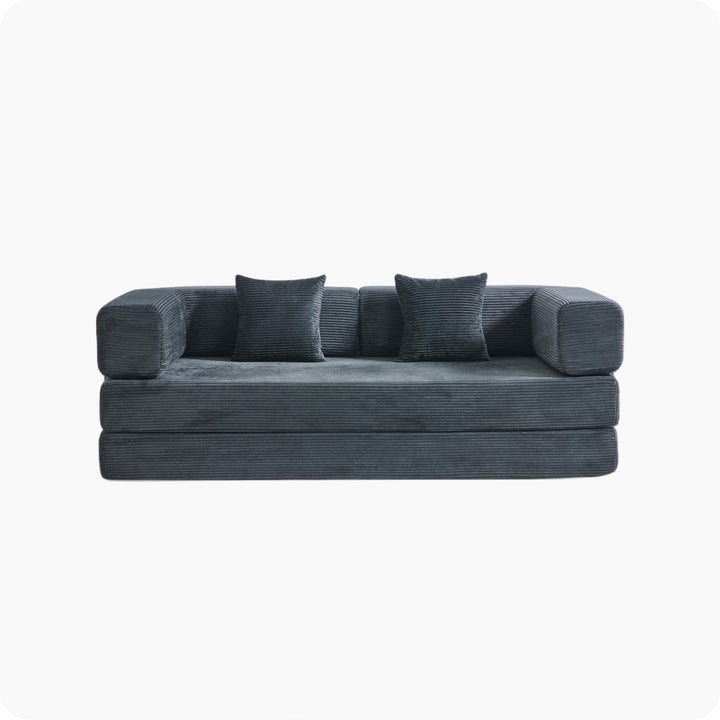
Let us apply these principles to a specific market leader. The DeskOne FoldFlex is a prime example of modern adaptive design. When we evaluate how long do compressed couches last in the context of this product, we analyze its weight and mechanism.
Weight as an Indicator of Quality: The FoldFlex weighs 43 kg. In the furniture industry, weight is often a proxy for quality. A light couch usually means low-density foam and a hollow frame. A 43 kg weight for a 200 × 100 × 70 cm unit indicates a substantial amount of high-density material is present. This mass suggests that the internal structure is solid, not filled with air.
Mechanical Simplicity: The fold-out design of the FoldFlex contributes to its longevity. Traditional sofa beds rely on complex metal springs and hinges that rust, squeak, and snap. The FoldFlex utilizes an adaptive fold-out mechanism with integrated metal side handles. By minimizing moving mechanical parts, the risk of catastrophic failure is drastically reduced. We recommend this type of "geometry-based" conversion over mechanical conversion for longevity.
6. Compressed vs. Traditional Couches: A Durability Comparison
Is a compressed couch inferior to a traditional showroom piece? Not necessarily. In many cases, traditional couches use low-grade foam wrapped in batting to create a "plush" showroom feel that flattens within months. Compressed couches, by necessity, use higher resiliency foam to survive the shipping process.
The 10-Year Timeline
A high-quality traditional sofa with a hardwood frame and springs might last 15-20 years. A high-quality compressed sofa with high-density foam typically lasts 7-12 years before the foam begins to lose significant support. However, the price point of compressed furniture is often half that of traditional luxury brands, making the "cost per year of use" remarkably efficient.
7. Expert Tips to Extend Your Couch's Life
Regardless of how long do compressed couches last on paper, user behavior dictates the reality. To maximize the lifespan of your FoldFlex or similar unit, we recommend the following professional maintenance protocols:
- Rotation is Key: If your compressed couch doubles as a bed, do not sleep in the exact same spot every night. Rotate the orientation if possible, or sit in different areas to distribute the compression load evenly across the high-density foam.
- Allow Full Expansion: Upon unboxing, wait the full recommended time (often 24-72 hours) before heavy use. Using the couch while the foam is still expanding can damage the cell structure before it fully sets.
- Fabric Care: Corduroy is durable, but dust settles in the ribs. Vacuum regularly with a soft brush attachment to prevent grit from acting like sandpaper on the fibers.
- Handle with Care: The integrated metal side handles on the DeskOne FoldFlex are designed for transition, not for dragging the unit across rough surfaces. Lift, do not drag, to preserve the structural integrity of the base.
8. Summary Comparison Table
The following table provides a general lifespan expectation based on material composition, helping you answer how long do compressed couches last based on what is inside the box.
| Component Quality | Estimated Lifespan | Typical Signs of Failure | Maintenance Requirement |
|---|---|---|---|
| Low Density Foam (<25kg/m³) | 1 - 3 Years | Permanent impressions, sagging | None (Disposable) |
| Medium Density Foam | 3 - 5 Years | Softening, loss of shape | Regular rotation |
| High Density Foam (e.g., FoldFlex) | 7 - 12+ Years | Gradual softening | Vacuuming, rotation |
| Traditional Spring/Hardwood | 15+ Years | Fabric wear, spring noise | Re-upholstery |
9. Frequently Asked Questions
Does compressing a couch permanently damage the foam?
No, provided the manufacturer uses high-quality High-Resiliency (HR) foam. HR foam is designed to rebound. However, leaving a couch in the box for months beyond the recommended unboxing time can lead to permanent compression. We recommend unboxing immediately upon delivery.
How does the DeskOne FoldFlex compare to a standard futon?
Standard futons often use cotton batting or low-grade foam pads that become lumpy quickly. The Desk One FoldFlex compressed couches utilize high-density foam blocks. This provides consistent orthopedic support that does not separate or lump over time, offering a significantly longer lifespan than a traditional futon mattress.
Can I replace the foam in a compressed couch?
In many modular designs, yes. Since the structure is foam-based rather than frame-based, it is often possible to unzip the cover and replace the foam core after a decade of use, effectively giving you a brand-new couch for a fraction of the price. Check if the specific model has removable covers.
Is the "Charcoal Grey" fabric prone to fading?
All fabrics will fade in direct sunlight over time. However, the ribbed corduroy used on the FoldFlex creates depth and shadows that mask minor fading better than flat weaves. To ensure the answer to how long do compressed couches last is maximized, position the furniture away from direct, harsh UV exposure.
10. References
- Polyurethane Foam Association (PFA). "Guidance on Foam Density and Durability."
- ASTM International. "Standard Test Methods for Flexible Cellular Materials—Slab, Bonded, and Molded Urethane Foams."